Our growth is accelerating! After four months of frustration we finally found a way to successfully connect to the Internet by buying a wireless modem with an alternative company, so now our four desktops and four laptops in the office are all connected.
Our volunteer “dream team” has four new members:
Hans van de Werfhorst (“Yogeshvar”), 56, from Netherlands, who has known Prout since 1974, and gave the first Prout lecture in Venezuela in 1978 when he was working in South America for three years as an “acarya” (spiritual teacher).
Taraka, 20, activist from Brazil
Dave Heighway, 35, from Canada, doing graduate studies in development and international relations in Denmark, is here full time until May.
Brian Landever, 24, high school teacher from USA
The work has changed dramatically, with daily morning meetings full of exciting ideas. In addition, several part-time volunteers are helping us, including university students.
Our current projects include:
1. Preparing an interview questionnaire that we will do with 50 cooperatives in the Barlovento area.
2. Preparing to give a series of Prout lectures at Caracas universities.
3. Preparing a project proposal to make an illustrated cooperative training manual.
Because we have so many volunteers now, we are doing several construction projects: renovating the bathroom (finished), building a sleeping loft, lockers, and more office furniture.
The Mondragón Cooperative Corporation in the Basque Country of Spain has accepted José Albarron (“Sarvajiit”), president of the PRIV Board of Directors, for a one-month scholarship training program in cooperatives. They will pay his air ticket, food, lodging and all expenses for this invaluable course during March.
For those of you who, like me, were concerned at President Hugo Chavez’s recent declaration of executive powers, I highly recommend reading the very thoughtful and balanced analysis by our friend, Gregory Wilpert, at: http://www.venezuelanalysis.com/articles.php?artno=1953

Dada Maheshvarananda's Blog concerning PROUT, the Progressive Utilisation Theory
11 February 2007


13 January 2007
VISIT TO MONDRAGÓN
On the morning of January 3, 2007, when many people were still on holidays, Mikel Lezamiz, Director of Cooperative Dissemination, was waiting for us. Four of us had driven together eight hours through the fog to the city of Mondragón in the Basque Region of northern Spain. Mikel is like a living cooperative encyclopedia – ask him anything, and he remembers the facts.
This is the largest and most successful cooperative network in the world. Begun in the 1950s, today more than 50,000 workers are employed in 120 cooperatives, all of them part of the Mondragón Cooperative Corporation (MCC).
The Mondragón Cooperative Experience has ten basic principles, three more than the International Cooperative Alliance (ICA):
1. Open admission
2. Democratic organization
3. Sovereignity of labor
4. Instrumental and subordinate character of capital
5. Participatory management
6. Payment solidarity
7. Intercooperation
8. Social transformation
9. Universality
10. Education
Payment solidarity is not one of ICA’s stated goals. Mikel explained that the annual starting salary today in every co-op is €13,000-14,000 (approximately US$17,000). A one-to-three wage differential in worker salaries lasted more than 20 years. However in order to avoid losing their top management to private companies, they have raised the highest salaries to 4.5 times more than the minimum in most of the cooperatives, in the Caja Laboral Bank to 8 times more, and the Chief Executive Officer of the Mondragón Cooperative Corporation gets 9 times more, or €126,000 (US$164,000) per year.
All new workers in the Basque Country start with a six to twelve month trial period. If they demonstrate that they are good workers and accept the cooperative system, they can become a member by investing about one year's salary – they can get a bank loan to pay this over 36 months at 3.7% interest. But the benefits of being a cooperative member are impressive. For €30 per month, all members and their families get full health coverage. For €15 per month, members can send their children to the best private school, which is also run as a cooperative. There is subsidized housing, and, most important, they have job security for life! If for any reason their cooperative needs to layoff workers, they will be transferred to another cooperative. Of the 120 cooperatives, only 12 of them lost money last year, and a total of 110 workers had to be relocated to other co-ops.
Education, research and innovation have always been essential to MCC’s growth, and much profits are invested every year into the MCC University (with 4000 students), seven other cooperative schools, and 11 research and development cooperatives. The sophistication and high technology of the hundreds of products produced in cooperative factories make them very competitive throughout Spain and the world, earning the corporation €11 billion in total sales.
Each cooperative is responsible for its own marketing. Most of the cooperatives are industrial or in services – there are only four agricultural cooperatives, and some of some of those are very small. In the same way that the Mondragon Cooperative Corporation is not actively promoting cooperativism to local farmers, they also do not promote it in MCC factories and companies in the other regions of Spain or in 15 other countries; however the MCC board has finally passed a resolution to begin cooperative dissemination throughout their global network of companies. Women comprise 42% of the total cooperative members of Mondragón, but sadly they are elected to only 15% of management positions.
Every cooperative has a general assembly of all members which decides the general policies and strategies of the cooperative and appoints and removes by secret vote the members of its Governing Council and the Account Auditors. The Governing Council in turn appoints the managing director and other directors.
I asked whether they have had problems with dishonesty or corruption. Mikel said, “Each cooperative has both internal and external audits. In addition there is strong social control, meaning our Basque culture and the cooperative spirit that has developed for 50 years encourages group trust and solidarity. So far,” he said, knocking on wood, “there have only been three cases to my knowledge of members stealing from a cooperative. None of them were top managers, all of them were discovered relatively quickly, and all three were dismissed by the general assembly of their respective cooperatives.”
Last year 18 activists from the Brazilian Landless Peoples Movement trained for two months in Mondragon to learn how to start and manage co-ops effectively. This year a similar one-month course will begin in March; the Prout Research Institute is trying to convince SUNACOOP and other Venezuelan organizations to send participants.
We are committed to continuing our study of the very successful Mondragon Cooperative Experience, and we carried many books and materials when we left. Afterwards Mikel sent an email in which he wrote:
“I have been reading on the Internet about Prout, and I have been surprised by its clear and pragmatic ideas of the socio-economic development of communities. I believe that a lot of similarities exist between the philosophy of our Mondragón Cooperative Experience and that of Prout: for example, the importance of economic decentralization (in MCC each cooperative is independent and it maintains its own autonomy), participatory democracy, the balance between the social and the economic, etc. In general, I agree with all that appears in the Prout Study Guide.
“Allow me to make the following reflection. Perhaps the biggest difference that exists between you and us is that we have always avoided being too belligerent with the nearby economic systems (capitalist and communist) to avoid arousing suspicions and to make our own road, being pragmatic in the search for balance between the economic efficiency of our companies and the social development of the region. Our main mission is undoubtedly to generate wealth in the society. Another significant difference (allow me to say it) could be that our cooperativism is more directed at the level of labor. Outside of the company we are not too sensitive with spiritual life (although we do strive for social transformation toward a more fair, equal and united society). I believe that you are more spiritual than us and your philosophy of life and your practice of it is very consistent with the values that you propagate. I would say that you demonstrate cooperativism 24 hours a day, while we do so only during the eight working hours! Of course in our personal and family lives we also try to continue with solidarity and cooperative values, but without being very perfectionist.
“In conclusion I hope that we meet again and that in way or another it improves this world. With sincere cooperative greetings,
“Mikel Lezamiz, Director of Cooperative Diffusion MCC”
This is the largest and most successful cooperative network in the world. Begun in the 1950s, today more than 50,000 workers are employed in 120 cooperatives, all of them part of the Mondragón Cooperative Corporation (MCC).
The Mondragón Cooperative Experience has ten basic principles, three more than the International Cooperative Alliance (ICA):
1. Open admission
2. Democratic organization
3. Sovereignity of labor
4. Instrumental and subordinate character of capital
5. Participatory management
6. Payment solidarity
7. Intercooperation
8. Social transformation
9. Universality
10. Education
Payment solidarity is not one of ICA’s stated goals. Mikel explained that the annual starting salary today in every co-op is €13,000-14,000 (approximately US$17,000). A one-to-three wage differential in worker salaries lasted more than 20 years. However in order to avoid losing their top management to private companies, they have raised the highest salaries to 4.5 times more than the minimum in most of the cooperatives, in the Caja Laboral Bank to 8 times more, and the Chief Executive Officer of the Mondragón Cooperative Corporation gets 9 times more, or €126,000 (US$164,000) per year.
All new workers in the Basque Country start with a six to twelve month trial period. If they demonstrate that they are good workers and accept the cooperative system, they can become a member by investing about one year's salary – they can get a bank loan to pay this over 36 months at 3.7% interest. But the benefits of being a cooperative member are impressive. For €30 per month, all members and their families get full health coverage. For €15 per month, members can send their children to the best private school, which is also run as a cooperative. There is subsidized housing, and, most important, they have job security for life! If for any reason their cooperative needs to layoff workers, they will be transferred to another cooperative. Of the 120 cooperatives, only 12 of them lost money last year, and a total of 110 workers had to be relocated to other co-ops.
Education, research and innovation have always been essential to MCC’s growth, and much profits are invested every year into the MCC University (with 4000 students), seven other cooperative schools, and 11 research and development cooperatives. The sophistication and high technology of the hundreds of products produced in cooperative factories make them very competitive throughout Spain and the world, earning the corporation €11 billion in total sales.
Each cooperative is responsible for its own marketing. Most of the cooperatives are industrial or in services – there are only four agricultural cooperatives, and some of some of those are very small. In the same way that the Mondragon Cooperative Corporation is not actively promoting cooperativism to local farmers, they also do not promote it in MCC factories and companies in the other regions of Spain or in 15 other countries; however the MCC board has finally passed a resolution to begin cooperative dissemination throughout their global network of companies. Women comprise 42% of the total cooperative members of Mondragón, but sadly they are elected to only 15% of management positions.
Every cooperative has a general assembly of all members which decides the general policies and strategies of the cooperative and appoints and removes by secret vote the members of its Governing Council and the Account Auditors. The Governing Council in turn appoints the managing director and other directors.
I asked whether they have had problems with dishonesty or corruption. Mikel said, “Each cooperative has both internal and external audits. In addition there is strong social control, meaning our Basque culture and the cooperative spirit that has developed for 50 years encourages group trust and solidarity. So far,” he said, knocking on wood, “there have only been three cases to my knowledge of members stealing from a cooperative. None of them were top managers, all of them were discovered relatively quickly, and all three were dismissed by the general assembly of their respective cooperatives.”
Last year 18 activists from the Brazilian Landless Peoples Movement trained for two months in Mondragon to learn how to start and manage co-ops effectively. This year a similar one-month course will begin in March; the Prout Research Institute is trying to convince SUNACOOP and other Venezuelan organizations to send participants.
We are committed to continuing our study of the very successful Mondragon Cooperative Experience, and we carried many books and materials when we left. Afterwards Mikel sent an email in which he wrote:
“I have been reading on the Internet about Prout, and I have been surprised by its clear and pragmatic ideas of the socio-economic development of communities. I believe that a lot of similarities exist between the philosophy of our Mondragón Cooperative Experience and that of Prout: for example, the importance of economic decentralization (in MCC each cooperative is independent and it maintains its own autonomy), participatory democracy, the balance between the social and the economic, etc. In general, I agree with all that appears in the Prout Study Guide.
“Allow me to make the following reflection. Perhaps the biggest difference that exists between you and us is that we have always avoided being too belligerent with the nearby economic systems (capitalist and communist) to avoid arousing suspicions and to make our own road, being pragmatic in the search for balance between the economic efficiency of our companies and the social development of the region. Our main mission is undoubtedly to generate wealth in the society. Another significant difference (allow me to say it) could be that our cooperativism is more directed at the level of labor. Outside of the company we are not too sensitive with spiritual life (although we do strive for social transformation toward a more fair, equal and united society). I believe that you are more spiritual than us and your philosophy of life and your practice of it is very consistent with the values that you propagate. I would say that you demonstrate cooperativism 24 hours a day, while we do so only during the eight working hours! Of course in our personal and family lives we also try to continue with solidarity and cooperative values, but without being very perfectionist.
“In conclusion I hope that we meet again and that in way or another it improves this world. With sincere cooperative greetings,
“Mikel Lezamiz, Director of Cooperative Diffusion MCC”
21 September 2006
News of the Prout Research Institute of Venezuela
The effort to buy the perfect house for the PRI-V continues. In the meantime, we have rented temporary office space in the upstairs of the Ananda Marga Kindergarten. Last year a new roof was put on, and this week the bathroom is being repaired, the interior is being painted, two new doors are being hung, and office furniture is being purchased. The school telephone will be transferred to the PRI-V: 00-58-212-633-0131.
We have applied for broadband Internet connection, and the company has promised to install it within 10 days. (Of course things don’t move as quickly in Venezuela as in other countries!) For those who have visited Venezuela, you will realize how happy we are to have employed Diipanii to cook a delicious breakfast and lunch for the staff five days a week!
The first meeting of the Venezuelan Board of Directors has taken place. We are confirming the proposed legal constitution and bylaws of the Institute Foundation. Eight Venezuelan Proutists (Sarvajiit, Satyam, Manujesh, Mrtyunjaya, Tapas, Sulocana, Laksman, Krsna Priya) plus Didi Ananda Sadhana and myself will be members. We will also collectively decide on inviting some other professionals who are sympathizers to sit on the Board.
Eleven senior Proutists in other countries have so far agreed to be on the International Advisory Board of the PRI-V: Hiranmaya (US), Karma Rasa (US), Dharmadeva (Brazilian economist moving to NYC), Dhruva (US), Suprabhata (US), Nirainjana (Palestine/US), Dayabatii (US), Mayajiit (US), Citsvarupa (US), Aradhana (US), Shiva (PhDc Philippines), Jayanta Kumar (Australia). We are still waiting for confirmation from the others we have invited.
Our multi-lingual web site is under construction by professional web-designer Dada Unmantranandajii. We are finishing the various menu texts in English and Spanish, and we hope to have it ready in the first week of October.
Despite his university diploma, his former job as an architect and despite the apartment in Budapest that he owns, the US government refused to give a visa to our LFT Dharmapal so that he could transit in Miami Airport for 150 minutes. Now he is struggling to re-route his air ticket to avoid touching that country that is forbidden to him. Atideva, another excellent brother from Hungary will arrive here this week.
Fabio, in consultation with half a dozen IT experts in other countries, continues to develop the detailed plans for our computer system. The hardware infrastructure will be desktop computers and one (file) server. We will buy the expensive components in Miami and assemble them here. The system will run on Linux (Ubuntu) with Open Office which we are confident will fulfill our needs and be consistent with our ideological direction. The network will be secured via a firewall, and will operate on a RAID system, with two hard disks continually mirroring the stored information, so in case of a disk crash, the other disk can carry on operations seamlessly. Weekly backups on rewritable DVDs stored in different locations will prevent electronic knowledge loss even in catastrophe scenarios.
Asiima is researching about Venezuelan inflation, devaluation and other economic indicators. Other researchers in other countries have started looking into cooperatives as well.
Please send your suggestions and best wishes.
We have applied for broadband Internet connection, and the company has promised to install it within 10 days. (Of course things don’t move as quickly in Venezuela as in other countries!) For those who have visited Venezuela, you will realize how happy we are to have employed Diipanii to cook a delicious breakfast and lunch for the staff five days a week!
The first meeting of the Venezuelan Board of Directors has taken place. We are confirming the proposed legal constitution and bylaws of the Institute Foundation. Eight Venezuelan Proutists (Sarvajiit, Satyam, Manujesh, Mrtyunjaya, Tapas, Sulocana, Laksman, Krsna Priya) plus Didi Ananda Sadhana and myself will be members. We will also collectively decide on inviting some other professionals who are sympathizers to sit on the Board.
Eleven senior Proutists in other countries have so far agreed to be on the International Advisory Board of the PRI-V: Hiranmaya (US), Karma Rasa (US), Dharmadeva (Brazilian economist moving to NYC), Dhruva (US), Suprabhata (US), Nirainjana (Palestine/US), Dayabatii (US), Mayajiit (US), Citsvarupa (US), Aradhana (US), Shiva (PhDc Philippines), Jayanta Kumar (Australia). We are still waiting for confirmation from the others we have invited.
Our multi-lingual web site is under construction by professional web-designer Dada Unmantranandajii. We are finishing the various menu texts in English and Spanish, and we hope to have it ready in the first week of October.
Despite his university diploma, his former job as an architect and despite the apartment in Budapest that he owns, the US government refused to give a visa to our LFT Dharmapal so that he could transit in Miami Airport for 150 minutes. Now he is struggling to re-route his air ticket to avoid touching that country that is forbidden to him. Atideva, another excellent brother from Hungary will arrive here this week.
Fabio, in consultation with half a dozen IT experts in other countries, continues to develop the detailed plans for our computer system. The hardware infrastructure will be desktop computers and one (file) server. We will buy the expensive components in Miami and assemble them here. The system will run on Linux (Ubuntu) with Open Office which we are confident will fulfill our needs and be consistent with our ideological direction. The network will be secured via a firewall, and will operate on a RAID system, with two hard disks continually mirroring the stored information, so in case of a disk crash, the other disk can carry on operations seamlessly. Weekly backups on rewritable DVDs stored in different locations will prevent electronic knowledge loss even in catastrophe scenarios.
Asiima is researching about Venezuelan inflation, devaluation and other economic indicators. Other researchers in other countries have started looking into cooperatives as well.
Please send your suggestions and best wishes.
19 August 2006
Translation of Finnish article
 (English translation of the article that appeared in the Finnish magazine of the Service Center for Development Corporation ("Kepa") For more about Kepa, see: www.kepa.fi/English
Lifestyle: Volunteering
Dada Maheshvarananda, 53, who travels constantly around the world, describes himself with the words "lifetime volunteer". The monk, who is originally from the U.S.A, is a true global citizen. "I have travelled around the world for the last three years, and previously I lived for many years in
Maheshvarananda tries to connect universal, spiritual values to social change in the developing countries. He is involved in different school projects in the developing countries, for according to his opinion education is the best way to alleviate poverty. "I have written dozens of articles about the need for social change, and the book After Capitalism was published in 2003." Maheshvarananda is not content with just writing, but teaches yoga and meditation to prisoners in
An inspiring visit to Helsinki
I just returned from six days in Finland to publicize the release of the Finnish edition of “After Capitalism: Prout’s Vision for a New World ”. Didi Annapurna with the help of Mitra translated it with great struggle. This edition includes contributions by two famous Finnish writers, psychohistorian Juha Siltala.and Heidi Hautala, Finnish Member of Parliament and former EU Parliament and Green Party presidential candidate.
The
With only a few days to prepare, a successful two-hour Prout lecture was given to 16 people in the public library. Professor Tapani Köppä, who has coordinated and taught about cooperatives for 40 years, came and explained about the 3000 existing worker-owned enterprises in the country. The major alternative radio station recorded a one-hour interview with Didi Annapurna and myself. We also took part in a peace march.
10 August 2006
The History and Future of Finland According to Sarkar’s Social Cycle
The recent discovery in Susiluola (in the
About 10,000 years ago the last Ice Age came to an end and the Finnish land surface began to re-emerge from under the receding ice and to rise up from the sea. Humans then came from
.
The evolution of some viprans (intellectuals) during this early tribal period can be seen in the shamans, wise and respected spiritual leaders of their tribe who were believed to have healing abilities and a special relationship with the spirit world. Their search for knowledge is expressed in some of the older epic poems of the Kalevala. However, the tribes for the most part continued to be led by warriors. The population of
The transition from a ksattriya-led to a vipra-led society started with the introduction of Christianity from
The publication in 1765 of Anders Chydenius’ book, The National Gain, proposing free trade (11 years before Adam Smith’s famous book, The Wealth of Nations), is a good indication of how capitalists (vaeshyas) were increasingly becoming the new power-brokers in
Starting in 1918 with the class war between the Red Guards and the Whites, some disgruntled ksattriyas and vipras tried unsuccessfully in various ways to lead shudras on a Communist platform to overthrow the vaeshyas. Despite the
According to Sarkar’s social cycle theory,
A fundamental change of consciousness is needed. Courageous fighters (ksattriyas) and thinkers (vipras) should lead a radical, grassroots popular transformation to establish a more orderly, disciplined and ethical society based on economic justice and solidarity.
Prout's message for Finland
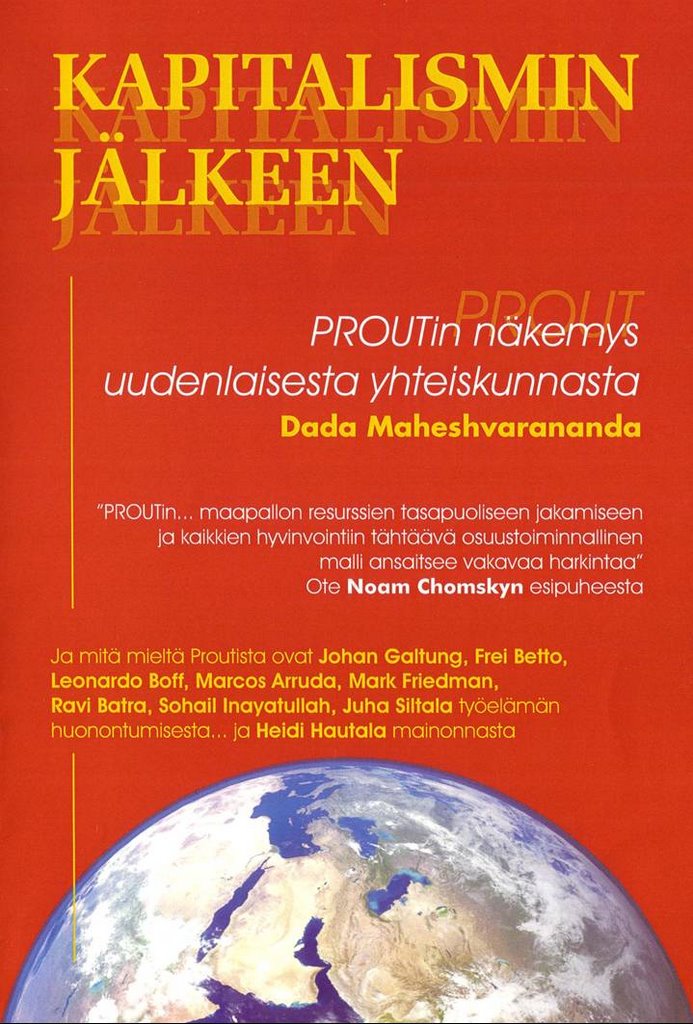
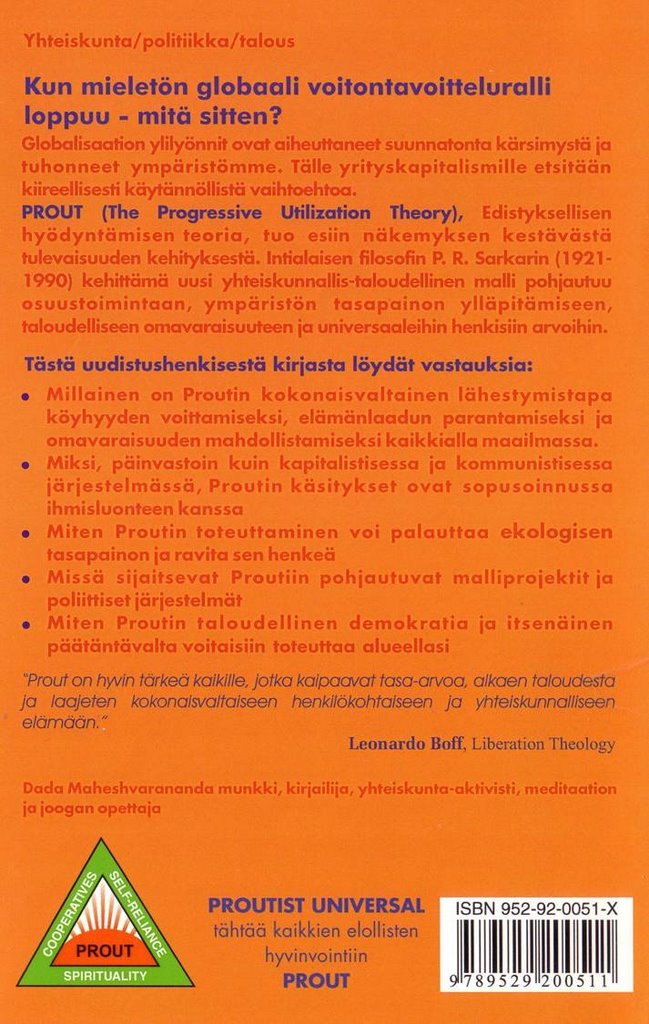
With much happiness, I will return to Helsinki for a week on August 11 to "launch" the Finnish version of my book "After Capitalism". The following remarks are from the introduction I wrote for the Finnish edition:
According to the Finnish Government Institute for Economic Research (VATT), the top 10 percent of the population owns almost 40 percent of all the property and share capital. Much more economic inequality appears when calculating the wealth of the few thousand millionaires and billionaires, whose holdings are widely spread through nebulous financial networks. Greater tax breaks for the rich means the welfare state is weakening.
During the last 20 years, a large portion of the Finnish economy has been taken over by international investment funds, who own major shares of Nokia and the other large Finnish companies. Why is it that the majority of stores in
Unfortunately capitalism does not work very well for
Finnish people experience the psychological side effects of global capitalism. The materialistic, consumer outlook, where everything seems to have a price tag, supports the existential outlook, “I buy, therefore I am!” Yet I believe the Finnish people, like most people in the world, long for true peace, happiness and unconditional love, which are not really satisfied in a consumer culture. Instead, working ever harder just to increase their income, or just to survive, under increasing stress, people experience alienation, loneliness and depression. Tragically, the suicide rate in
We need something better: a holistic approach that fulfills the physical, mental and spiritual needs of each person. A world where nobody suffers poverty or hunger, where the resources are shared for the welfare of everyone. Where every human being is encouraged to develop their creativity, their talents, the higher dimensions of their being. How to do this is Prout’s vision for a new world.
21 May 2006
Prout in Manila, Baguio and Ilocos Norte, Philippines
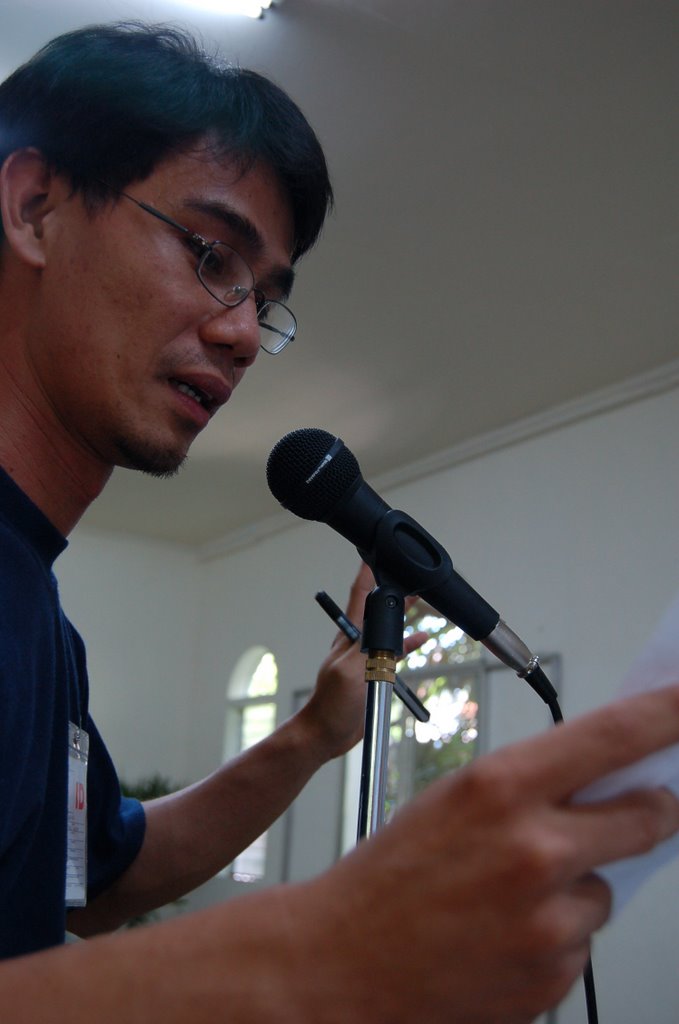
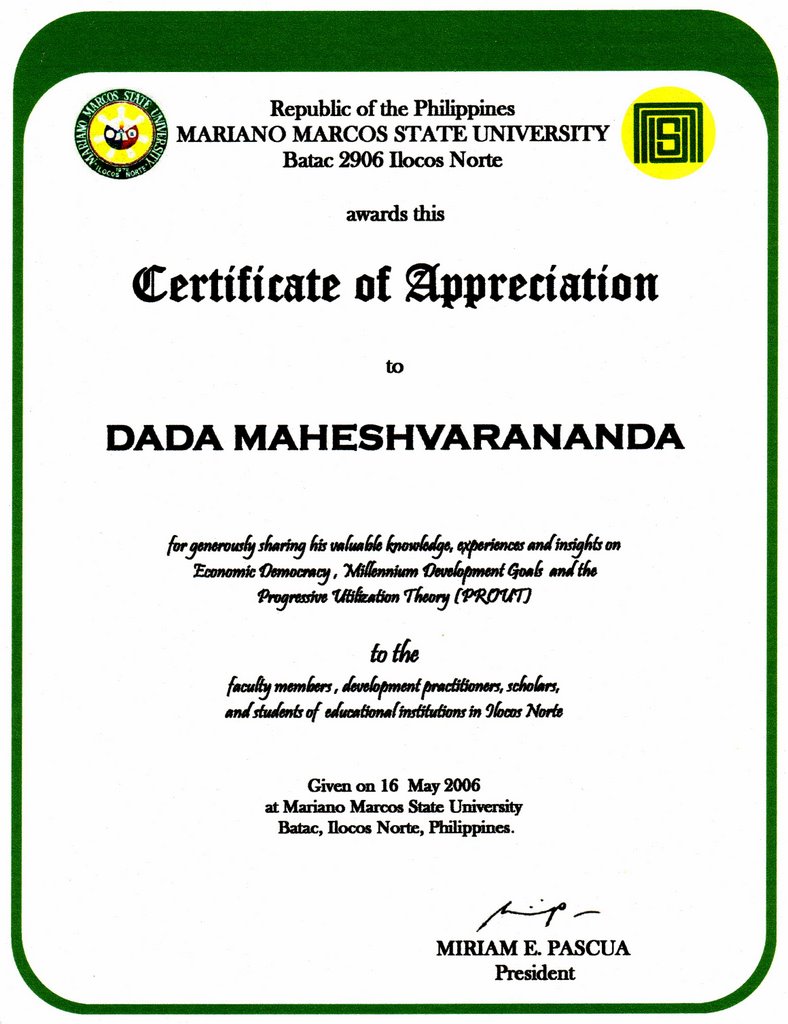
My 10-day visit to Maharlika was an incredible inspiration for me. In addition to meeting dozens of old friends, I got the chance to meet and share experiences with hard-working Prout activists.
The National Prout Board of Maharlika is composed of: Dada Gayatrananda, Diivakar, Vishva, Rajnikanta, Subhrata, Paritosh, Jayadeva, Ajiir, Arun, Mahesh, Iishvar, Surendra and Ramesh. Their recent accomplishments include renovating part of the Proutist Universal office in Manila, regularizing the legal registration of PU, holding a monthly study circle, organizing two successful one-day leadership training sessions and a regular radio show (tel. +63-9203225249).
Ang Kasama Samaj activist leaders who attended the seminar were: Dada Devapriyananda, Manorainjan (a labor leader from Clark Airbase), Iishvara (Central Luzon), Ram Prasad (Baguio), Jagatmitra (Secretary General), Lalit Mohan, Parvati, Jagat (Cebu, former editor of Prout Times), Japamala (Cebu, Maharlika Artists and Writers Association), Shiva (Ilocos Norte) and Nareshvar. (Ang KaSaMa office: 11 Union Village, Barangay Culiat, Tandang Sora, Quezon City, tel. +63-2-931-4882, mobile: 09197863739) See www.angkasama.net
During my last 48 hours, I took a bus to
After seven blissful hours, I jumped on another bus to the far north of
I found a very inspiring speech that Sarkar gave during his June 1968 visit to Maharlika. He said:
“Movement in the physical realm means the construction of a society led by spiritual revolutionaries [sadvipras]… Sinners will oppose you, but you will have to face the challenge... You are human beings, because you are fighting against immoralists.
“In the psychic realm you have to establish righteousness by removing the germs of crude mentality. Everywhere in the world today the crude intellect dominates. It is your duty to replace it with your righteous intellect…
“In the spiritual realm, your task is to establish Cosmic ideation… It is your duty to show the right path to society in those three spheres...
“Work with the Supreme’s infinite power and with infinite speed. Victory is surely yours.”
(from “Accomplish Your Work with this Body Only”, A'nanda Vacana'mrtam Part 23)
20 May 2006
The Last Empire
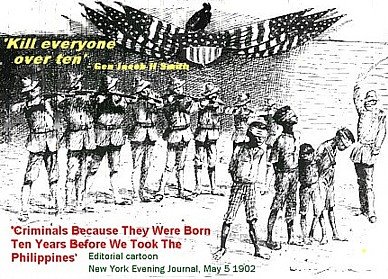
Empires began to appear soon after the first cities made the necessary administrative structures possible. Approximately 77 empires have existed in world history. Understandably, historians are not in complete agreement regarding the starting and ending dates of each one, and whether or not some should qualify.
P.R. Sarkar describes the psychological root of imperialism. When people become increasingly engrossed in materialism (what he called “carbonic pabula”) their mind gradually sinks towards crude matter. Greed increases, desiring the wealth of others. “Capitalism, state capitalism, communism, nationalism, communalism [groupism based on religion], parochialism [selfish pettiness or narrowness of views], provincialism [sense of superiority because of one’s province or area], socialism, caste-imperialism, male chauvinism, lingualism [that one’s language is superior]… are all the same psychic ailments in various forms and figures.”
The list below is arranged chronologically according to when the empire began. The present-day country where the seat of the empire was located is included if not obvious from the name.
- Abyssinian Empire (Ethiopia, 3000 BC–1974 AD)
- Elamite Empire (
- Akkadian Empire (
- Ur III Empire (Iraq, c. 2100–2000 BC)
- Old Babylonian Empire (Iraq, c. 1900–1600 BC)
- Egyptian Empire (1550–1070 BC)
- Hittite Empire (
- Israelite Empire (c. 1000–922 BC)
- Assyrian Empire (
- Magadhan Empire (India, c. 550–350 BC)
- Persian Empire (Iran, c. 550–330 BC)
- Athenian Empire (
- Macedonian Empire (
- Seleucid Empire (
- Mauryan Empire (
- Teotihuacano Empire (Mexico, c. 300-700 BC)
- Chinese Empire (221 BC–1912 AD)
- Parthian Empire (
- Goguryeo Empire (Korea, c. 100 BC–668 AD)
- Roman Empire (27 BC–476 AD)
- Second
- Gallic Empire (
- Palmyrene Empire (Syria, 260–272)
- Britannic Empire (286–297)
- Gupta Empire (
- Islamicate Empire (Saudi Arabia, c. 630–1924)
- Tibetan Empire (c. 7th–11th century)
- Bulgarian Empire (681–1018; 1185–1396)
- Khmer Empire (
- Chola Empire (South Indian Tamil, c. 9th–13th century)
- Venetian Empire (
- Tu'i
- Irish Empire (1005–1014)
- Kongo Empire (Congo, 1100-1884)
- Danish colonial empire (c.1200-1953)
- Latin Empire (
- Trapezuntine Empire (
- Nicaean Empire (
- Mongol Empire (1206–1394)
- Majapahit Empire (
- Ilkhanate (
- Serbian Empire (1345–1371)
- Vijayanagara Empire (
- Aztec Empire (
- Timurid Empire (
- Inca Empire (
- Spanish Empire (1492–1898)
- Portuguese Empire (1495–1975)
- Mogul Empire (Pakistan, 1526–1857)
- Swedish Empire (1561–1878)
- Dutch colonial empire (1602-1975)
- Maratha Empire (
- Russian Empire (1721–1917)
- Vietnamese Empire (1802–1883)
- Austrian Empire (1804–1867)
- French Empire (1804-1814, 1815, 1852-1870)
- Haitian Empire (1804–1806, 1849–1859)
- Mexican Empire (1822–1823, 1864–1867)
- Brazilian Empire (1822–1889)
- Belgian Empire (1865–1962)
- Austro-Hungarian Empire (1867–1918)
- German Empire (1871–1918)
- Italian Colonial Empire (1889–1943)
- Korean Empire (1897–1910)
- Japanese Empire (1910-1945)
- Soviet Empire (Russia, 1922–1991)
- German Third Reich (1933–1945)
- AMERICAN EMPIRE (1898- ?)
76 empires have ended. Only one remains. It began in 1898 when it stole Maharlika (the
18 May 2006
RECENT CHANGES IN “MAHARLIKA” (The Philippines)
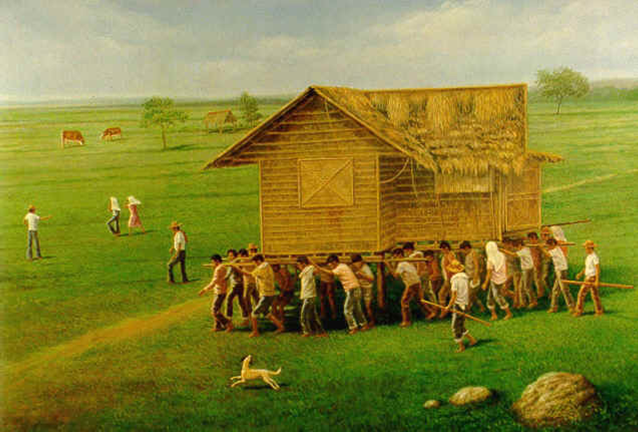
When I landed in
I had worked in
Of course I wasn’t happy about every change that had taken place. The World Bank reports that air pollution kills 2,000 Filipinos a year. In addition, in the cities of Metro Manila,
Automobiles create 80 percent of the pollution, reducing everyone’s life expectancy. Tiny particles (“particulate matter”) penetrate deep into respiratory tissue and directly into the bloodstream. The good news is that eating more fresh fruits and vegetables help to reduce the creation of “free radicals” in the body caused by this particulate matter.
Deforestation has also worsened. From 1980 to 2000 the total forest coverage in Maharlika was reduced by half! Today only 19 percent of the country is covered by forest. The tragic results are land degradation, erosion, flash floods, draught and mudslides. (Ian Coxhead and Sisira Jayasuriya, “Environment and Natural Resources” in The Philippine Economy: Development, Policies and Challenges,
The West prides itself on its science and technology, yet it ignores the warnings of world scientists about the effects of pollution and global warming. First in 1992, scientists from around the world signed a joint letter asking world leaders to sign the global warming treaty at
Predictably, these compelling warnings have been for the most part ignored by the mainstream media in the
I checked the Forbes magazine website (www.forbes.com) to see who are the richest Filipinos – as expected, the three billionaires were also the wealthiest people 20 years before:
- Lucio Tan, self-made wealth from cigarettes, liquor, Philippine Airlines and Philippine National Bank. Total worth: US$ 1.7 billion.
- Henry Sy & family, self-made, owns 23 shopping malls: US$1.5 billion.
- Jaime Zobel de Ayala & family, inherited, Ayala Corporation owns real estate, water and telecom: US$1.3 billion.
By checking the Forbes lists during the last ten years, it can seen that each one is two to three times richer. So I asked each audience, “Are you?” Invariably the reply came, “No, we’re poorer!”
Professor Arsenio M. Balisacan of the University of the Philippines in his article “Poverty and Inequality” in The Philippine Economy: Development, Policies and Challenges, Oxford University Press, 2003 gives many statistics demonstrating how the widening gap between rich and poor has resulted in most of the gains of national economic growth being eaten up by the rich, leaving the poor with very little benefit.
Of course Prout’s response to this extraordinary widening gap between rich and poor is to remind everyone that the world’s physical resources are limited. If individuals accumulate too much, there will not be enough for everyone. So every country should decide maximum salaries, wealth and land ownership. The only reason to pay more is to motivate people to make a greater effort to benefit society.
I had the pleasure of meeting again Alejandro Lichauco, a radical economist cited in the bibliography of my book. His most recent work is Hunger, Corruption and Betrayal: A Primer on
Subscribe to:
Posts (Atom)