21 May 2006

Prout in Manila, Baguio and Ilocos Norte, Philippines


My 10-day visit to Maharlika was an incredible inspiration for me. In addition to meeting dozens of old friends, I got the chance to meet and share experiences with hard-working Prout activists.

The National Prout Board of Maharlika is composed of: Dada Gayatrananda, Diivakar, Vishva, Rajnikanta, Subhrata, Paritosh, Jayadeva, Ajiir, Arun, Mahesh, Iishvar, Surendra and Ramesh. Their recent accomplishments include renovating part of the Proutist Universal office in Manila, regularizing the legal registration of PU, holding a monthly study circle, organizing two successful one-day leadership training sessions and a regular radio show (tel. +63-9203225249).

Ang Kasama Samaj activist leaders who attended the seminar were: Dada Devapriyananda, Manorainjan (a labor leader from Clark Airbase), Iishvara (Central Luzon), Ram Prasad (Baguio), Jagatmitra (Secretary General), Lalit Mohan, Parvati, Jagat (Cebu, former editor of Prout Times), Japamala (Cebu, Maharlika Artists and Writers Association), Shiva (Ilocos Norte) and Nareshvar. (Ang KaSaMa office: 11 Union Village, Barangay Culiat, Tandang Sora, Quezon City, tel. +63-2-931-4882, mobile: 09197863739) See www.angkasama.net

During my last 48 hours, I took a bus to Baguio City in the mountains, where Arjuna and others organized a Prout talk for me in a beautiful art center call Vocas (5th floor of La Azotea Building). Forty people came with just a few hours notice, and I personally taught meditation to four people.

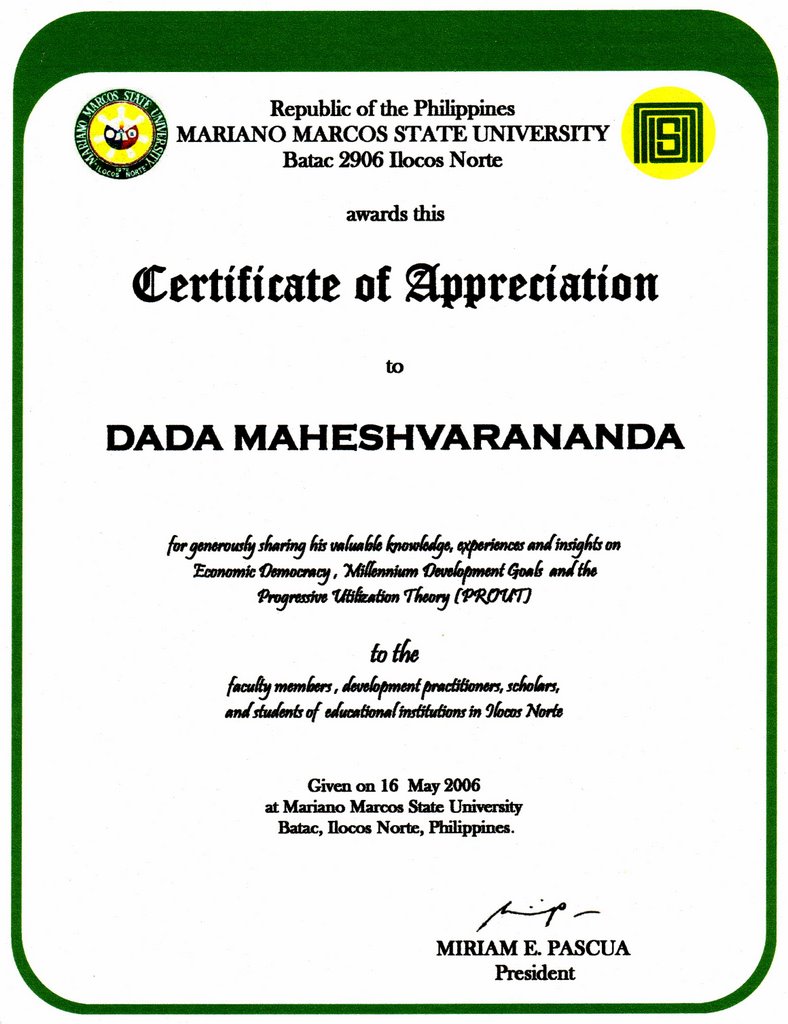
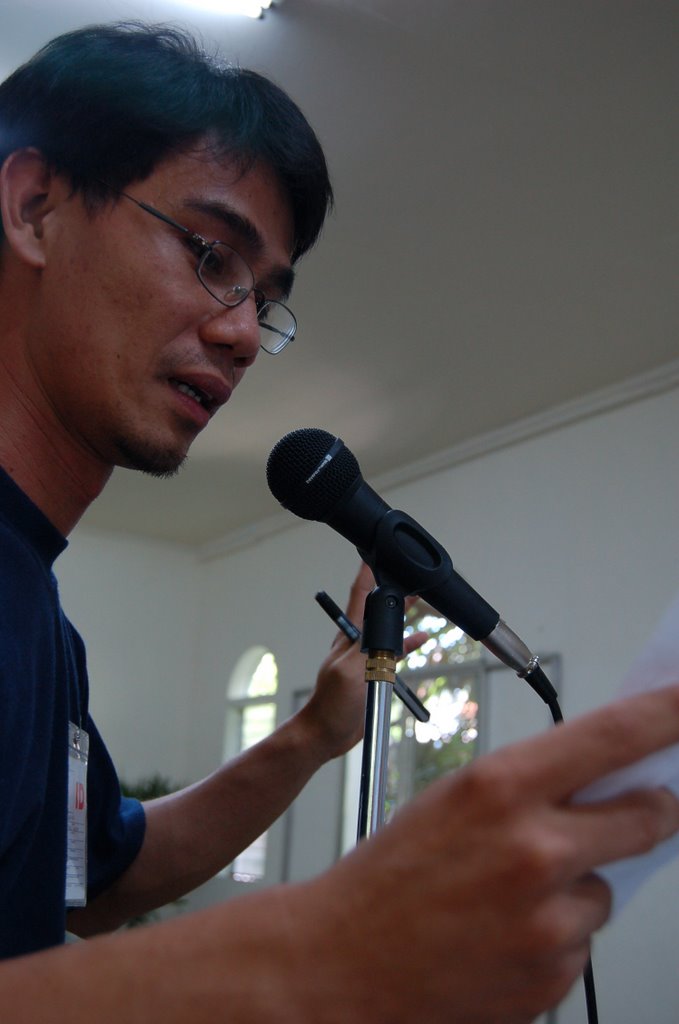
After seven blissful hours, I jumped on another bus to the far north of Luzon Island. Brother Shiva (see photo), professor of political science and coordinator of TIMPUYOG People's Movement, organized a lecture at Mariano Marcos State University. Their certificate of appreciation for Prout is above.

I found a very inspiring speech that Sarkar gave during his June 1968 visit to Maharlika. He said:

“Movement in the physical realm means the construction of a society led by spiritual revolutionaries [sadvipras]… Sinners will oppose you, but you will have to face the challenge... You are human beings, because you are fighting against immoralists.

“In the psychic realm you have to establish righteousness by removing the germs of crude mentality. Everywhere in the world today the crude intellect dominates. It is your duty to replace it with your righteous intellect…

“In the spiritual realm, your task is to establish Cosmic ideation… It is your duty to show the right path to society in those three spheres...

“Work with the Supreme’s infinite power and with infinite speed. Victory is surely yours.”

(from “Accomplish Your Work with this Body Only”, A'nanda Vacana'mrtam Part 23)

20 May 2006

The Last Empire


An empire is defined as: “A set of regions locally ruled by governors in the name of an emperor; a large, multi-ethnic state ruled from a single center at least partly by coercion based on greed.”

Empires began to appear soon after the first cities made the necessary administrative structures possible. Approximately 77 empires have existed in world history. Understandably, historians are not in complete agreement regarding the starting and ending dates of each one, and whether or not some should qualify.

P.R. Sarkar describes the psychological root of imperialism. When people become increasingly engrossed in materialism (what he called “carbonic pabula”) their mind gradually sinks towards crude matter. Greed increases, desiring the wealth of others. “Capitalism, state capitalism, communism, nationalism, communalism [groupism based on religion], parochialism [selfish pettiness or narrowness of views], provincialism [sense of superiority because of one’s province or area], socialism, caste-imperialism, male chauvinism, lingualism [that one’s language is superior]… are all the same psychic ailments in various forms and figures.”

The list below is arranged chronologically according to when the empire began. The present-day country where the seat of the empire was located is included if not obvious from the name.

  1. Abyssinian Empire (Ethiopia, 3000 BC–1974 AD)
  2. Elamite Empire (Iran, 2700-539 BC)
  3. Akkadian Empire (Iraq, c. 2350–2150 BC)
  4. Ur III Empire (Iraq, c. 2100–2000 BC)
  5. Old Babylonian Empire (Iraq, c. 1900–1600 BC)
  6. Egyptian Empire (1550–1070 BC)
  7. Hittite Empire (Turkey, c. 1460–1180 BC)
  8. Israelite Empire (c. 1000–922 BC)
  9. Assyrian Empire (Syria, c. 900–612 BC)
  10. Magadhan Empire (India, c. 550–350 BC)
  11. Persian Empire (Iran, c. 550–330 BC)
  12. Athenian Empire (Greece, c. 477–404 BC)
  13. Macedonian Empire (Greece, c. 338–309 BC)
  14. Seleucid Empire (Greece, 323–60 BC)
  15. Mauryan Empire (India, 321–185 BC)
  16. Teotihuacano Empire (Mexico, c. 300-700 BC)
  17. Chinese Empire (221 BC–1912 AD)
  18. Parthian Empire (Iran, c. 200 BC–224 AD)
  19. Goguryeo Empire (Korea, c. 100 BC–668 AD)
  20. Roman Empire (27 BC–476 AD)
  21. Second Persian Empire (224–651)
  22. Gallic Empire (France, 260–274)
  23. Palmyrene Empire (Syria, 260–272)
  24. Britannic Empire (286–297)
  25. Gupta Empire (India, c. 320–550)
  26. Byzantine Empire (Turkey, 330–843)
  27. Islamicate Empire (Saudi Arabia, c. 630–1924)
  28. Tibetan Empire (c. 7th–11th century)
  29. Bulgarian Empire (681–1018; 1185–1396)
  30. Ghana Empire (c. 750–1240)
  31. Khmer Empire (Cambodia, 802–1462)
  32. Holy Roman Empire (843–1806)
  33. Chola Empire (South Indian Tamil, c. 9th–13th century)
  34. Venetian Empire (Italy, c. 900–1797)
  35. Tu'i Tonga Empire (Pacific Islands, 950–1875?)
  36. Irish Empire (1005–1014)
  37. Kongo Empire (Congo, 1100-1884)
  38. Genoa Empire (Italy, c. 1100–1797)
  39. Danish colonial empire (c.1200-1953)
  40. Latin Empire (Turkey, 1204–1261)
  41. Trapezuntine Empire (Greece, 1204–1461)
  42. Nicaean Empire (Greece, 1204–1261)
  43. Mongol Empire (1206–1394)
  44. Mali Empire (c. 1240–1541)
  45. Majapahit Empire (Indonesia, c. 1293–1500)
  46. Ilkhanate (Iran, c. 1256–1338)
  47. Ottoman Empire (Turkey, 1299–1922)
  48. Serbian Empire (1345–1371)
  49. Siam Empire (Thailand, 1350–1909)
  50. Vijayanagara Empire (India, c. 1350–1700)
  51. Aztec Empire (Mexico, 1375–1521)
  52. Timurid Empire (Turkey, 1401–1505)
  53. Inca Empire (Peru, 1438–1533)
  54. Songhai Empire (Burkina Faso, 1464–1591)
  55. Spanish Empire (1492–1898)
  56. Portuguese Empire (1495–1975)
  57. British Empire (c. 1497—1960s)
  58. Mogul Empire (Pakistan, 1526–1857)
  59. Swedish Empire (1561–1878)
  60. Dutch colonial empire (1602-1975)
  61. Maratha Empire (India, 1674–1761)
  62. Russian Empire (1721–1917)
  63. Vietnamese Empire (1802–1883)
  64. Austrian Empire (1804–1867)
  65. French Empire (1804-1814, 1815, 1852-1870)
  66. Haitian Empire (1804–1806, 1849–1859)
  67. Mexican Empire (1822–1823, 1864–1867)
  68. Brazilian Empire (1822–1889)
  69. Belgian Empire (1865–1962)
  70. Austro-Hungarian Empire (1867–1918)
  71. German Empire (1871–1918)
  72. Italian Colonial Empire (1889–1943)
  73. Korean Empire (1897–1910)
  74. Japanese Empire (1910-1945)
  75. Soviet Empire (Russia, 1922–1991)
  76. German Third Reich (1933–1945)
  77. AMERICAN EMPIRE (1898- ?)

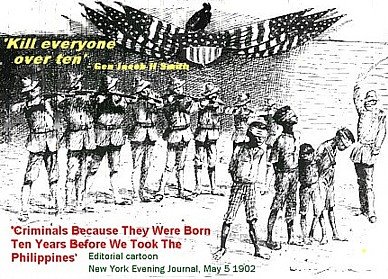
76 empires have ended. Only one remains. It began in 1898 when it stole Maharlika (the Philippines), Guam and Puerto Rico at the close of the Spanish-American War. See http://www.americanempireproject.com/.

18 May 2006

RECENT CHANGES IN “MAHARLIKA” (The Philippines)


When I landed in Manila International Airport last week, the customs officer asked me if I had anything to declare. “Yes,” I said. “I declare that I am very happy to be back after 16 long years!” She looked at me and said, “I bet you looked different then, without your white hair.” “Yes, ma’am, that’s a fact!”

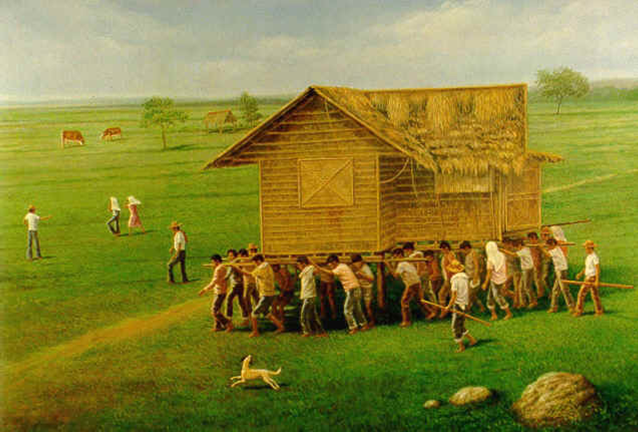
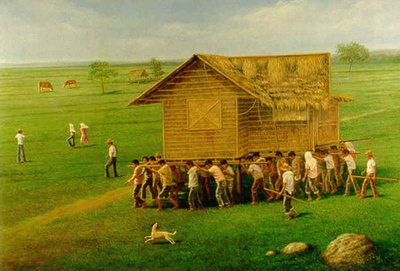
I had worked in Manila from 1981-1990, so this time I met dozens of old friends, and adults came up to me and told me I had performed their baby-naming ceremony! It was truly wonderful to see again the spirit of Bayanihan, the Tagalog word which means to move a house together. This is the spirit of solidarity, of making the impossible become possible (painting by Joselito E. Barcelona, 1993).

Of course I wasn’t happy about every change that had taken place. The World Bank reports that air pollution kills 2,000 Filipinos a year. In addition, in the cities of Metro Manila, Cebu, Davao and Baguio 9,000 suffer chronic bronchitis. Lost wages and medical treatment total Pesos 79.5 billion (US$1.5 billion) annually, 2 percent of the gross domestic product (GDP). This means that every Filipino spends around P 2,000 ($40) each year for treatment and medication for illnesses caused by air pollution.

Automobiles create 80 percent of the pollution, reducing everyone’s life expectancy. Tiny particles (“particulate matter”) penetrate deep into respiratory tissue and directly into the bloodstream. The good news is that eating more fresh fruits and vegetables help to reduce the creation of “free radicals” in the body caused by this particulate matter.

Deforestation has also worsened. From 1980 to 2000 the total forest coverage in Maharlika was reduced by half! Today only 19 percent of the country is covered by forest. The tragic results are land degradation, erosion, flash floods, draught and mudslides. (Ian Coxhead and Sisira Jayasuriya, “Environment and Natural Resources” in The Philippine Economy: Development, Policies and Challenges, Oxford University Press, 2003.)

The West prides itself on its science and technology, yet it ignores the warnings of world scientists about the effects of pollution and global warming. First in 1992, scientists from around the world signed a joint letter asking world leaders to sign the global warming treaty at Kyoto. Five years later even more signed a "Call to Action"– 1,500 scientists from 63 countries, including 110 Nobel Prize laureates. Then in 2001, 100 Nobel laureates issued a brief but dire warning of the profound dangers facing the world from global warming and the proliferation of small arms: “…To survive in the world we have transformed, we must learn to think in a new way. As never before, the future of each depends on the good of all.”

Predictably, these compelling warnings have been for the most part ignored by the mainstream media in the United States because they are contrary to the policies of the US government.

I checked the Forbes magazine website (www.forbes.com) to see who are the richest Filipinos – as expected, the three billionaires were also the wealthiest people 20 years before:

  1. Lucio Tan, self-made wealth from cigarettes, liquor, Philippine Airlines and Philippine National Bank. Total worth: US$ 1.7 billion.
  2. Henry Sy & family, self-made, owns 23 shopping malls: US$1.5 billion.
  3. Jaime Zobel de Ayala & family, inherited, Ayala Corporation owns real estate, water and telecom: US$1.3 billion.

By checking the Forbes lists during the last ten years, it can seen that each one is two to three times richer. So I asked each audience, “Are you?” Invariably the reply came, “No, we’re poorer!”

Professor Arsenio M. Balisacan of the University of the Philippines in his article “Poverty and Inequality” in The Philippine Economy: Development, Policies and Challenges, Oxford University Press, 2003 gives many statistics demonstrating how the widening gap between rich and poor has resulted in most of the gains of national economic growth being eaten up by the rich, leaving the poor with very little benefit.

Of course Prout’s response to this extraordinary widening gap between rich and poor is to remind everyone that the world’s physical resources are limited. If individuals accumulate too much, there will not be enough for everyone. So every country should decide maximum salaries, wealth and land ownership. The only reason to pay more is to motivate people to make a greater effort to benefit society.

I had the pleasure of meeting again Alejandro Lichauco, a radical economist cited in the bibliography of my book. His most recent work is Hunger, Corruption and Betrayal: A Primer on U.S. Neocolonialism and the Philippine Crisis, Citizen’s Committee on the National Crisis (CCNC), 2005, 115 pages, available online for $12.00 from www.marymartin.com. He writes on Thursdays and Sundays for The Daily Tribune and many of his articles can be found online by doing a Google search. He was imprisoned for three months and then kept under house arrest for two years by former dictator Ferdinand Marcos. In an “Open letter to President Gloria Macapagal-Arroyo” published recently, Lichauco wrote: “The Philippines is now a case of humanitarian disaster. Late last year, the Food and Nutrition Research Institution of the Department of Science and Technology (FNRI-DOST) released a survey finding that "8 out of 10 households are hungry." This is the first time, to our knowledge, that the government, through an important agency, acknowledged the fact that mass hunger--and not only mass poverty--now grips the lands.”

02 May 2006

A Training Center for Spiritual Revolutionaries


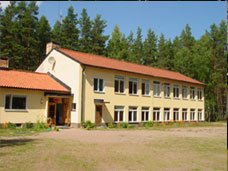
In the silent pine forests of southern Sweden lies a most inspiring center of transformation. Fourteen brothers and sisters have come from around the world to study there – from Argentina, France, Germany, Israel, Italy, Madagascar, Netherlands, Norway, Russia, Singapore and USA. They are highly motivated, and are literally putting their lives on the line.

They are in training to become nuns and monks. The color orange that they wear means they are dedicating their lives to the service of humanity. Though it differs from person to person, most spend about three years in training. In addition to chanting, practicing yoga asanas, reading spiritual philosophy, they are sitting for silent meditation 4-5 hours each day.

They also intensively study the spiritual and social philosophy of P.R. Sarkar, the founder of Prout. After passing all their exams, they then travel to India and are assigned to work in another continent from where they grew up.

The center was started in 1976, and hundreds who trained there have gone to six continents to serve humanity. I deeply enjoyed giving them Prout classes for two days and doing long meditation together. I told them that I have come to realize after 28 years of working as a monk, I am very much still “in training”! Every day I am learning, discovering, struggling to understand and to realize the deepest truths.

Then I drove to Stockholm where I stayed in the home of Proutists Krsnadeva and Sumana. I recorded nearly 3 hours of their personal experiences with the founder of Prout – incredible. Sumana said that in their last meeting together, Sarkar said, “You know, there are two kinds of people in this world, those who give, and those who get. Which kind are you?” She laughed and replied, “The kind that give, Baba.” But ever since that day, she realizes that so many people, even those on a spiritual path, are always concerned about and often criticize the quality of seminars, programs, etc., without looking for ways to contribute, to make it better. These stories are being transcribed now.

Five trainees plus other employees and interns are working in an organic bakery in Stockholm (www.sattvanaturbageriet.com). It’s an incredible beehive of activity round the clock. I also gave them a class on Thursday.

Then on Friday night I gave a lecture on Prout and Spiritual Values that they organized for the public – 35 people, both young and old, came. These people fill me with hope.

If you are ever uncertain about what to do in your life, and how you could contribute more to making a better world, there’s a beautiful, quiet place in southern Sweden that I highly recommend!

05 April 2006

Finland Social Forum

SOCIAL FORUM OF FINLAND

Over 1000 people came to the Third Finnish Social Forum in Helsinki on April 1-2, 2006. Once again it proved to be a most remarkable occasion to network with other activists, or, as Sarkar termed it, “to unite the moralists,” meaning those who are struggling for a better world.

Before the event Didi Annapurna wrote two one-page articles in Finnish that were posted on the Social Forum web page (www.sosiaalifoorumi.fi) after a long struggle with the organizers, insisting that small groups also have a right to be heard. One is about social change and Prout in Venezuela, and the other is called “Why Another World is Inevitable” that explains the spiritual dimension. She also spoke twice during the press conference before the event.

We organized five workshops during the event that were advertised in 50,000 copies of the Social Forum newspaper distributed around the country. I gave three: “From Evolution to Revolution,” “From Erosion of Democracy to Quadro-dimensional Economy,” and ; “Cardinal Human Values in the Economy” with Didi Annapurna. In addition, Dr. Sauli Siekkinen spoke on “Strength from Volunteering” and Didi Ananda Krpa, Dada Gatimayananda and Bhuwan Pathak from Vasudaiva Kutumbakam from Uttarakhand in the Central Himalayas talked about “Restoring Ecological Balance.” More than 70 people attended these workshops.

I was asked to sit on the panel of the workshop “A Debate on the World Social Forum” to explain the way in which Proutist Universal’s application to join the International Council of the WSF was rejected and how the promise two years ago to set up a process to hear our appeal has still not been prepared. In an amazing Cosmic “coincidence”, Oded Grajew, the Brazilian entrepreneur who originally conceived the idea of the World Social Forum and is on the WSF Secretariat, arrived a few minutes before I spoke. Afterwards he insisted, as did other members of the International Council who were present, that a proper and transparent decision-making process should be followed in this case.

This year I was also allowed to speak to the general audience in the closing ceremony. I told how during my last visit to Finland, I spoke at the University of Helsinki School of Economics where one of the professors insisted that in their belief, capitalism was good and the best way for developing countries to progress. I answered that of course capitalism works for some people, but not for everyone. On a wall in Mumbai was written, “Every morning I wake up on the wrong side of capitalism!” What the world needs today is an economic system that benefits everyone, so that we can share and utilize the resources of the world in a just and ecological way.

We sold 20 books and gave an interview to a magazine about social service work. Our success was a result of our continued efforts and struggles on the organizing committee, and the unity and the help of many Proutists, especially Omprakash and Mitra. The Finnish translation of “After Capitalism: Prout’s Vision for a New World” is now being reviewed and will be printed within a few months.

31 January 2006

World Social Forum Caracas VI March


Marching for a Better World

On the first day of the Sixth World Social Forum in Caracas thousands of activists marched from the Central Venezuelan University with the theme, “Another world is possible!”

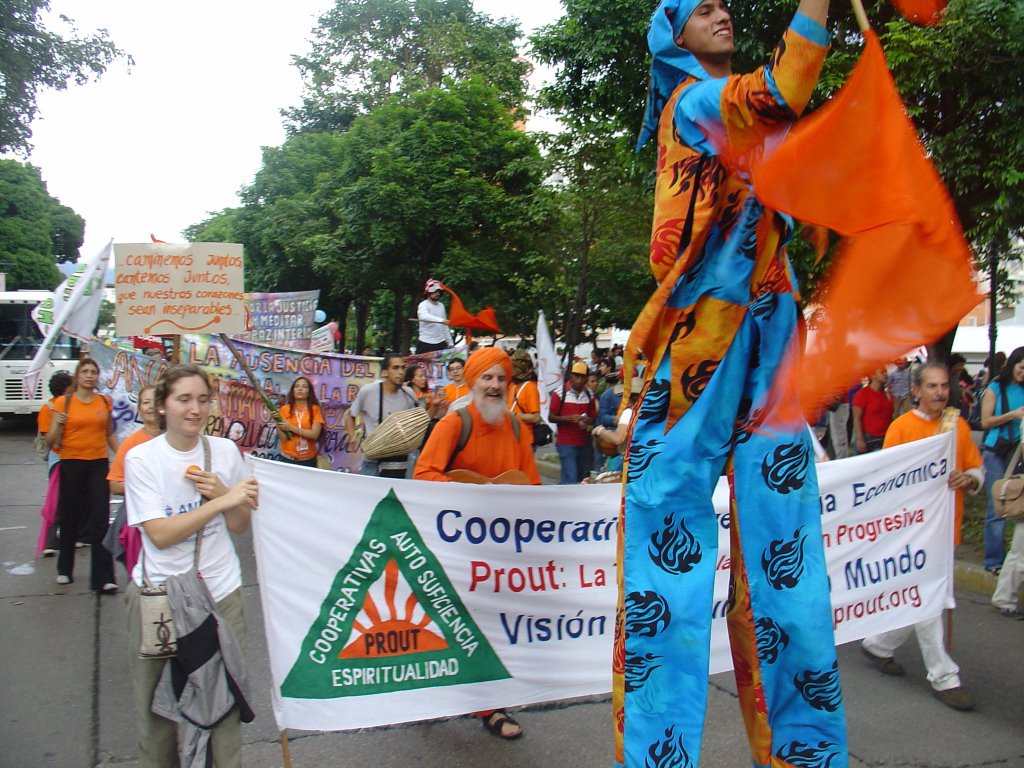
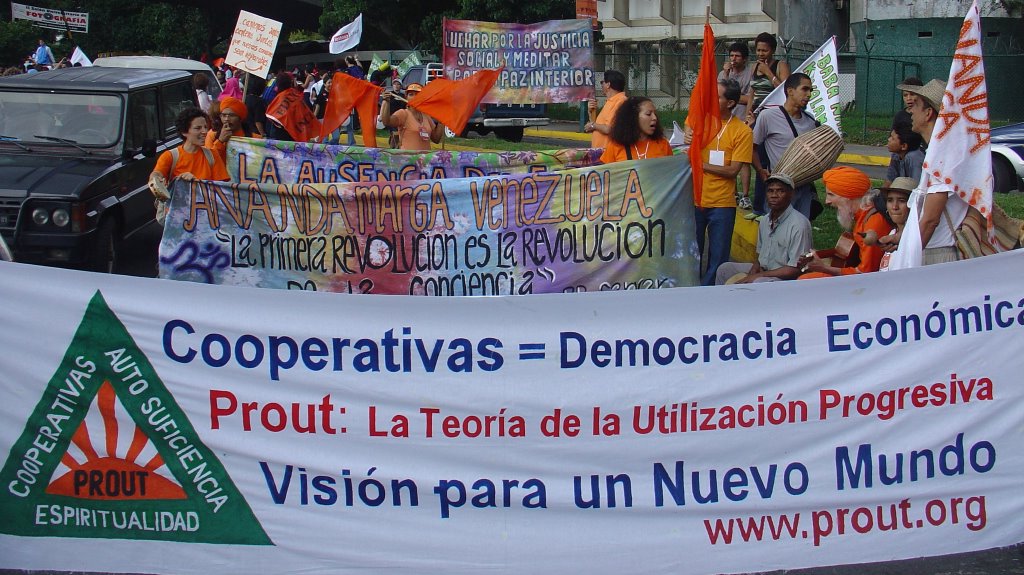
Thirty Proutists formed the most colorful and attractive group with the best music! Singing kiirtan continually, waving orange flags while they danced, they followed two wonderful clowns on stilts with orange flags. They carried four banners which said: “Cooperatives = Economic Democracy, Prout: A Vision for a New World”, “The first revolution is the revolution of consciousness,” The absence of universal spirit is the root of all problems – P.R. Sarkar,” and “Struggle for social justice and meditate for peace.” A slightly intoxicated older man did the whole march with us, playing some incredible bongo rhythms with our kiirtan for four hours.

Five thousand journalists are registered here at the WSF, and the majority were at the march, taking photos and filming. We gave dozens of interviews for both Venezuelan and international media. Events such as this one has tremendous potential for propagating the ideals of Prout and P.R. Sarkar. The more Proutists that can participate, the greater impact we can make.

26 October 2005

Venezuelan National Radio report (English translation)

American Monk Affirms that New Socialism Promotes Well-being.

Venezuelan National Radio September 11 2005

The monk Dada Maheshvarananda explained that the new form of progressive socialism promotes well-being and integration between nations, with the aim of sharing the resources of the planet for the common good.


Socialism of the 21st century, or "progressive socialism", promotes well-being and integration between nations, with the aim of sharing the resources of the planet for the common good, said American monk Dada Maheshvarananda.

During the conference Endogenous Development and Socialism of the 21st Century, held in the Hotel Rasil in Puerto La Cruz, Anzoategui, Maheshvarananda said that new socialism should be composed of three economic levels.

These levels, according to his point of view, are: A small scale free market made up of private businesses; a second level of cooperatives that makes up the majority of the economy; and a third which contains some state-owned enterprises.

The peace activist and promoter of the Progressive Utilization Theory (abbreviated Prout in English) with a multidimensional focus , which advocates economic democracy of the people, visited the Eastern Venezuelan city along with Steve Phillips, an expert in the creation and administration of cooperatives.

Prout is a socioeconomic theory that favors a progressive and dynamic adjustment to the political, economic, and social environment for the better development of human potential, both spiritual and psychological.

According to its hypothesis, the resources of the world should be distributed in a progressive and efficient manner with the intent of guaranteeing the basic necessities for all human beings.

The conference was organized by the national petroleum company (PetrĂ³leos de Venezuela, S.A or PDVSA), and served a varied group of people, including people from the petroleum industry, community groups, students and cooperative activists from the State of Anzoategui.

Venezuela, in turn, is showing the lecturer a new path to improve social and economic inequality.

In this sense, Dada Maheshvarananda commented that Venezuela is the first country in the world that is aggressively and vigorously fighting to eradicate poverty, which he characterized as a positive example for the world.

Furthermore he insisted that the country demonstrates the importance of eliminating the historical gap between the rich and poor, originating from the neoliberal economic model.

"Venezuela is a model for the future. Today every country is looking to the Venezuelan experience which widely favors those most in need. It is the path to the elimination of poverty," he proclaimed.

25 October 2005

The Catholic Church in Venezuela

Leonardo Boff, one of the founders of Liberation Theology, said, “"For
500 years, there have been two Catholic Churches in Brazil: one of the
rich and one of the poor.”" I have many friends who are priests and nuns
who work with the poor in Brazil. Their sacrifice and dedication are a
great source of inspiration to me.

I spoke at length with Charlie Hardy, a former Catholic priest from
Wyoming, USA, who has lived in Venezuela for more than 20 years. As a
priest with the Maryknoll Order, he used to live in a slum barrio with
no electricity, running water or toilets for many years. Because of his
strong sympathies with the poor, he is a supporter of the anti-poverty
programs of President Hugo Chavez. His insightful blog site, “"Cowboy in
Caracas: A Voice from the New America"” is: http://fuego.net/

Charlie explained that because of a historical Concordia agreement
between the government of Venezuela and the Vatican, only Venezuelan-born priests are allowed to become bishops in that country. A popular saying in the Church is that when a Venezuelan priest is newly ordained, he is told, “You have to decide, do you want to serve the people or become a bishop?” It means that if a priest decides to work with the poor, he will never be promoted in the Church heirarchy.

The Venezuelan bishops that are published in the newspapers invariably
criticize the Chavez government. (The newspapers are owned by the
superrich who are opposed to Chavez.) For example, Cardinal Rosalio
Castillo Lara said to journalists on Oct. 22 that Venezuelans ought to
“"deny recognition"” to the Chavez government and organize civil
disobedience against because it because it is, "“ill-fated and dangerous".”

High level Church officials criticize Chavez because he reduced
government spending for private schools, which affected Catholic
schools. During the April 2002 coup attempt, Cardinal Ignacio Velasco
tried to persuade Chavez to sign a letter resigning from the presidency
while he was under military arrest.

There is no archbishop in Caracas because the government does not
approve of the Vatican´s nominee.

There are a few progressive priests in Venezuela (Franciso Rondon in
Caracas, Obaldo Santana in Maracaibo who is second vice president of
Bishops Council, and Padre Paulo) who support the democratic reforms of
the government, including a bishop, so of course the previous admonition
is not always followed.

Introduction: What kind of world do you want?

Namaskar (this is a Sanskrit greeting which means “I greet the divinity in you with charms of my mind and the love of my heart”).

When I arrived in Europe in June 2003, Pranava from Hannover, Germany, generously lent me a small red 1990 Ford Escort. Two years later, Tilakapash in Lisbon donated a 1994 Fiat Punto S. I’ve been continually traveling, usually by car but sometimes by bus or plane, to Portugal, Spain, Germany, Netherlands, Belgium, Denmark, Switzerland, Italy, England, Wales, Scotland, Norway, Sweden, Finland, Iceland, Austria, Hungary and Poland. When people ask me where I’m based, I reply the global office of Proutist Universal is in Copenhagen, Denmark, but the truth is I visit there only occasionally.

I’ve been wonderfully charmed by the beautifully diverse cultures, history, languages and people in each country. In each country I’ve given talks about my book, “After Capitalism: Prout’s Vision for a New World” with preface by Noam Chomsky. This has been published so far in Portuguese, Spanish, and Hungarian, and will soon be published in Italian, German, and Japanese.

In my opinion, the most significant page of my book is one that most readers skip – the acknowledgements. More than 70 individuals and a few organizations are listed there, and there are still others who asked to remain anonymous. The names include economists, environmentalists, agricultural experts, activists, cooperative consultants, senior Proutists and others, from six continents. The value of the book lies in their contributions.

Everywhere I go, friends and strangers continually help me. They organize lectures, debates and workshops; arrange interviews with the media; cook vegetarian meals for me and offer a place to spend the night; hand me a badly-needed donation.

In every presentation, I bring up the powerful theme of the World Social Forum, “Another world is possible.” I ask the audience “What kind of world do you want?” Invariably the responses are nearly always the same: a world without war, hunger, poverty, or exploitation; with more economic equality, ecological protection, community and cooperation; with a better quality of life. I believe there is tremendous power in this common dream, because together, nothing is impossible.

How do we make that dream a reality? I think about this a lot. If you have some ideas, I’d love to hear them.